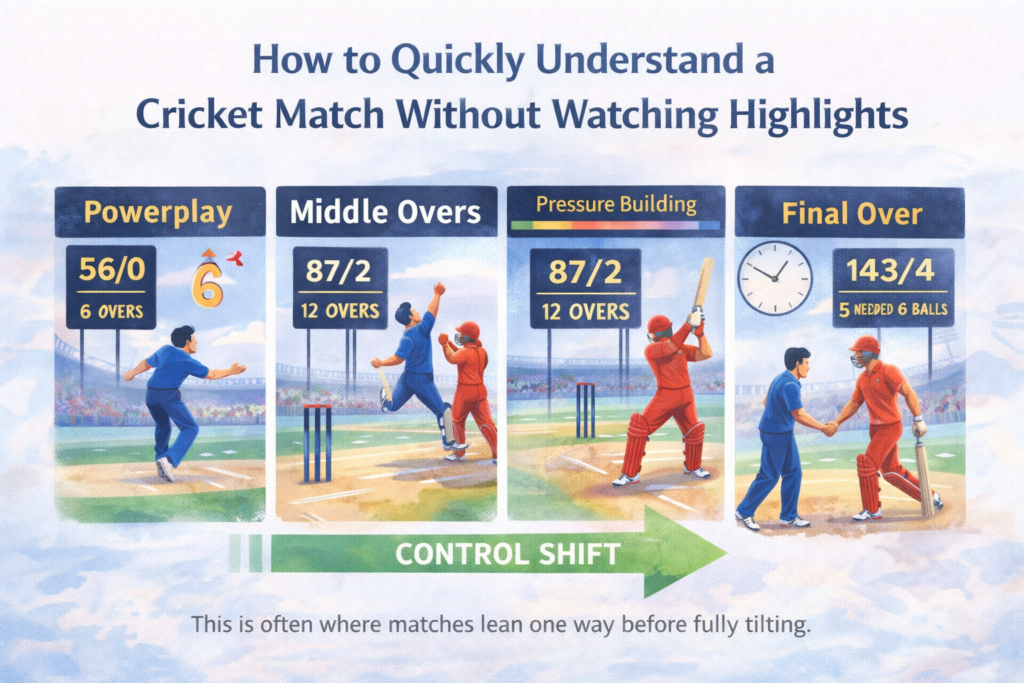
You don’t need to watch a cricket match live to grasp its significance. Ultimately, understanding the result depends less on seeing every delivery and more on identifying the key moments where the momentum of the game changed.
Why Highlights Often Miss the Point
Highlights are built for excitement, not understanding. They show boundaries, wickets, celebrations. What they don’t show very well is control.
A match can drift decisively in one direction without producing anything highlight-worthy. A quiet over. A partnership that never accelerates. A bowling spell that forces caution instead of mistakes.
Those moments rarely make the cut. But they matter.
Start With the Phase, Not the Score
When I’m trying to understand a match I didn’t watch, I don’t begin with the final score. I look at the phases.
Powerplay.
Middle overs.
Death.
Each phase answers a different question. Who started with intent? Who controlled the tempo? Who was forced to react instead of dictate?
If one team controls two out of three phases, the result usually makes sense—even if the margin looks narrow.
The Middle Overs Tell You More Than You Think
This took me longer than it should have to appreciate.
The middle overs don’t feel dramatic. They’re not supposed to. But this is where pressure either builds quietly or gets released before it ever becomes visible.
A chasing side that rotates strike comfortably here is rarely chasing blindly later. On the other hand, a team that loses momentum in this phase is often playing catch-up long before the final over arrives.
By the time the match reaches the end, the options are already limited.
Look for What Changed, Not What Finished It
A common mistake is to ask, “Who hit the winning runs?”
A better question is, “When did this stop being even?”
Sometimes it’s a broken partnership.
Sometimes it’s a bowler finishing an over without conceding a boundary.
Sometimes it’s a decision that feels safe in the moment and costly later.
Those shifts don’t always announce themselves. You have to look for them.
My Personal Take
I used to blame the last over for results that were clearly decided earlier. It’s an easy shortcut, and I’ve fallen into it more than once. Over time, watching patterns repeat, that habit faded.
Matches rarely turn suddenly.
They lean.
And then they fall.
Wrapping This Up
You don’t need highlights to understand a cricket match. You need context.
Look at the phases.
Notice where momentum stalled or flowed.
Pay attention to pressure before it became obvious.
Once you start doing that, the result stops feeling surprising—even if you never watched a single ball.